
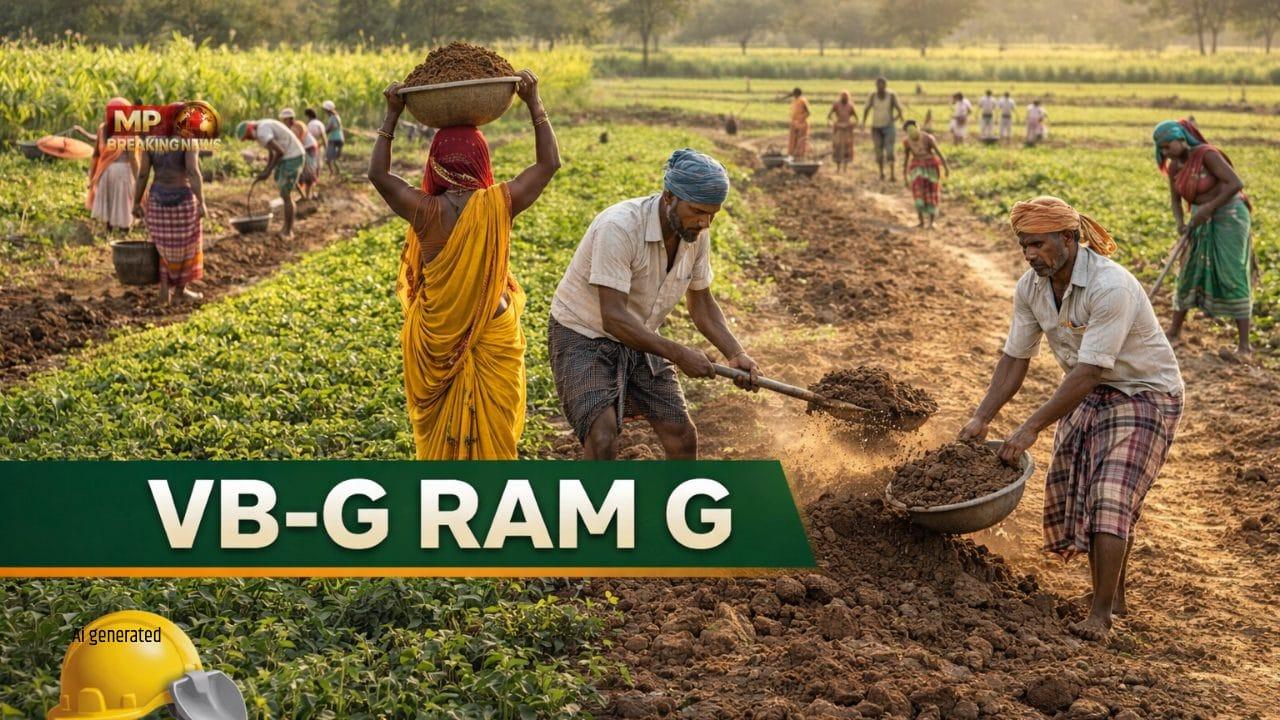
New Delhi: A significant shift in India’s rural employment landscape was formalized on Sunday after President Droupadi Murmu gave her assent to the Viksit Bharat–Guarantee for Rozgar and Ajeevika Mission (Gramin) Bill, 2025. The Rural Development Ministry confirmed that the new legislation has now officially become law, replacing the long-standing Mahatma Gandhi National Rural Employment Guarantee Act (MGNREGA).
The central feature of the new Act is an increase in guaranteed wage employment. While the previous MGNREGA framework ensured 100 days of work per rural household annually, the VB-G RAM G Act raises this statutory entitlement to 125 days for every financial year. Government officials stated that this move aims to strengthen income security across rural India.
Shift Towards ‘Viksit Bharat’
According to government officials, the new law is not merely a name change but a structural realignment. The legislation is designed to create an integrated rural employment framework that supports the national vision of ‘Viksit Bharat 2047’. The focus has shifted from a purely welfare-driven approach to one that emphasizes asset creation, accountability, and transparency.
Union Rural Development Minister Shivraj Singh Chouhan highlighted the dual purpose of the law. He stated that it is intended to support the comprehensive development of villages while ensuring employment security. The Minister also noted that the framework includes specific safeguards for vulnerable groups, including women, senior citizens, persons with disabilities, and communities belonging to Scheduled Castes and Scheduled Tribes.
Key Changes: Uniformity and Decentralization
Under the MGNREGA system, the base guarantee was 100 days, though states could extend this under specific conditions, and certain groups like Scheduled Tribe households in forest areas received longer coverage. The new Act removes these variances by establishing a uniform nationwide statutory guarantee of 125 days for all eligible rural households.
Another major structural reform is the empowerment of local institutions. The Act significantly enhances the role of gram panchayats and gram sabhas in the planning process. Decision-making authority regarding the selection of works has been decentralized. Officials explained that giving local bodies a stronger voice in identifying development priorities is expected to reduce procedural delays. The goal is to ensure projects align with actual local needs rather than top-down administrative targets.
Financial Allocation and Oversight
To support the rollout of the new mission, the government has earmarked more than ₹95,000 crore for its implementation. Addressing past criticism regarding material cost imbalances and fund utilization under the old scheme, officials noted that the new law introduces stricter mechanisms for transparency and monitoring.
The ministry emphasized that while the core promise of wage employment remains, the VB-G RAM G Act represents a transition toward a development-linked statutory framework. Detailed operational guidelines for the scheme are expected to be notified separately.